Most AI Is Built to Take a Job. Vibechat Is Built to Create One.
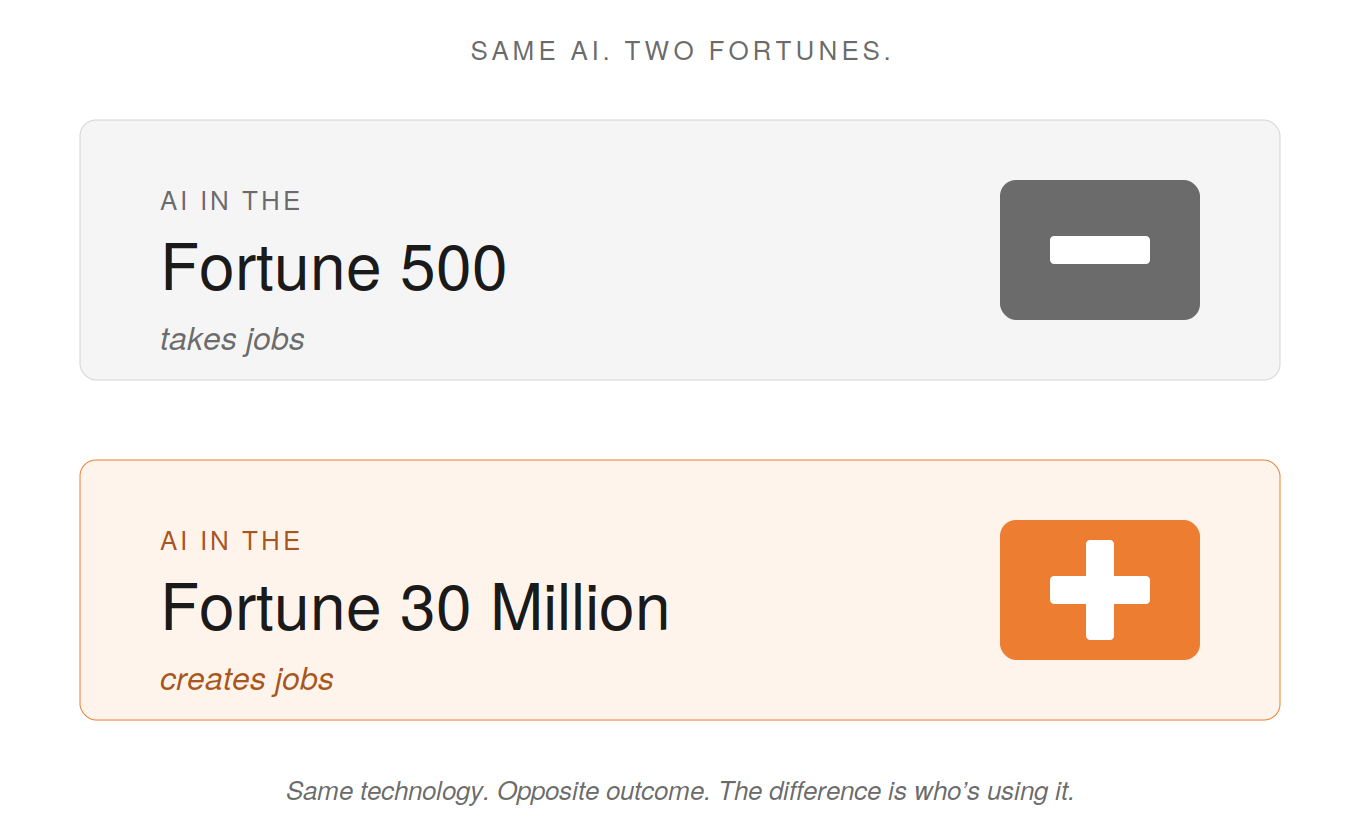
AI designed for the Fortune 500 takes jobs. AI designed for the Fortune 30 Million creates them.
Most AI Is Built to Take a Job. Vibechat Is Built to Create One.
AI designed for the Fortune 500 takes jobs. AI designed for the Fortune 30 Million creates them.
A Vibechat essay by Woody Jones
When Eric Schmidt told the University of Arizona’s class of 2026 that AI would transform their working lives, the students booed. They booed because they have heard exactly one AI story — the one the labs and the Fortune 500 have been telling for three years. In that story, AI takes jobs. Block laid off 4,000 employees in February 2026 — forty percent of its workforce — and CEO Jack Dorsey told shareholders the cuts came directly from the company’s adoption of “intelligence tools.” Salesforce CEO Marc Benioff cut his customer support division from 9,000 heads to 5,000 over the course of 2025, telling an interviewer that with Agentforce handling half the conversations, “I need less heads.” IBM froze hiring for roles AI can absorb. The narrative is consistent, the press releases are accurate, and the graduating class has internalized the conclusion.
The conclusion is correct, but it is only half the story. And the missing half is not a counterargument. It is a different product, built for a different business, producing the opposite outcome.
Two Fortunes
There is the Fortune 500. There is also the Fortune 30 Million.
The Fortune 500 is the list everyone knows — five hundred companies with most of the country’s capital, most of the press coverage, and most of the AI strategy memos. The Fortune 30 Million is the list nobody has named — the 30.4 million American businesses with no employees, plus the roughly 5 million with fewer than twenty. Together they are the overwhelming majority of American business by count, and they have been almost entirely absent from the AI conversation.
The two Fortunes use AI for opposite reasons, and produce opposite outcomes.
AI designed for the Fortune 500 takes jobs. AI designed for the Fortune 30 Million creates them.
Same technology. Opposite outcome. The difference is not the AI. The difference is which Fortune is using it.
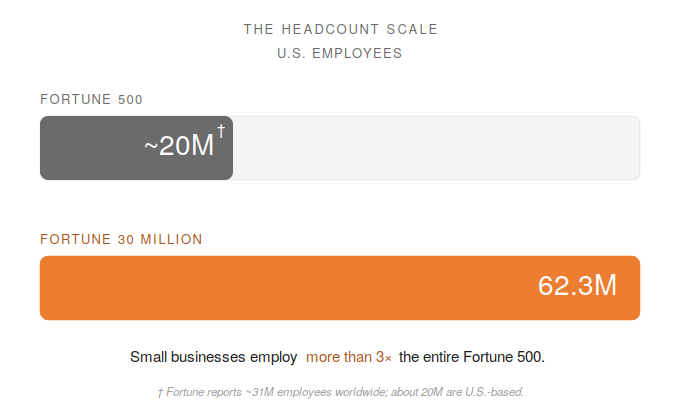
Start with where the jobs actually are. The Fortune 500 employs about 31 million people worldwide — but only about 20 million of those jobs are here in the United States. In contrast, American small businesses — the Fortune 30 Million — employ 62.3 million people, nearly all of them domestic. That is roughly 46% of the private sector workforce, and more than three times the Fortune 500's American headcount.
And when the Fortune 500 cuts, the American jobs go first. They are the most expensive line items on the balance sheet. Anyone who watched their parents lose a job to offshoring already knows the Fortune 500 playbook. For thirty years, American workers were the first to be replaced because American workers were the most expensive to keep. AI is not a new dynamic. It is the same dynamic with a faster engine.
That is how AI works inside a Fortune 500 company. It works differently inside a small business.
A Fortune 500 company already has all the customers it can serve. Its support lines are already staffed. Its calls are already getting answered. When AI makes the work cheaper, the company does not suddenly need more of the work done — it just needs fewer people to do it. The savings show up in the next quarterly earnings call. The headcount shows up in the next round of layoffs.
A small business is the opposite. The solo plumber misses three calls while she is under a sink. The two-person law firm loses leads at 7pm. The five-person dental practice cannot afford a front desk, so the phone rings out. The problem is not that these businesses have too many people. The problem is that they have too few, and the work that should be getting done is going undone. Every missed call, every after-hours inquiry, every unanswered DM is a customer the business never got.
When AI fills that gap, it is not replacing anyone. There was no one there to begin with. It is doing the work that was being lost, and turning it into revenue that pays for the next real hire. The plumber books the calls she used to miss and hires a second technician. The law firm captures the 7pm leads and brings on a paralegal. The dental practice stops losing patients to scheduling friction and adds a hygienist. The hire is mechanical. It falls out of the math.
Why one story is loud and the other is silent
The labs and the Fortune 500 did not have to leave this opening. They could have qualified their narrative. They could have said “AI will reduce headcount in companies that already have too many workers, and increase it in companies that have too few.” That qualified statement would still have been true, and it would have closed the rhetorical door.
They did not say that. They said, without qualification, that AI takes jobs. And they have repeated it for three years, in every earnings call and every press release, until it became the default frame in the general culture. Now the graduating class of 2026 boos when anyone suggests there is a second half to the story.
The opening is structural. The Fortune 500 cannot tell the second story even if it wanted to. Its entire AI investment thesis to shareholders is built on substitution. If a Fortune 500 CFO stood up tomorrow and said “actually, AI is mostly going to create jobs at small businesses,” the stock would drop. They are locked into the substitution narrative by the same logic that produced it.
The Fortune 30 Million is the only side that can tell the creation story. And right now, it has no spokesperson.
What changes when you name both Fortunes
Ask one question — which Fortune is using it? — and the entire AI jobs debate reorganizes.
Klarna’s 700 agents and the plumber’s second technician stop being contradictory data points. They become the predictable outputs of two different equations applied to two different demand environments. The Schmidt commencement speech stops being either correct or wrong. It becomes partial — in the way that a statement about “what cars do to cities” is partial if it never specifies whether the city is Manhattan or rural Wyoming.
The graduating class of 2026 should not be told that AI is good or bad. They should be told that the answer depends on which Fortune is using it. The story they have been hearing — the Fortune 500 story — is one of two. The other story, the one that runs through the Fortune 30 Million, is going to produce a great deal of hiring over the next several years. It will produce that hiring quietly, one second technician at a time, in shops and practices and firms that do not issue press releases.
What we built
Most AI is built to take a job. Vibechat is built to create one.
We are an AI Front Desk for the Fortune 30 Million — the channel that answers when the owner cannot. Every conversation the owner used to miss now converts. Every after-hours lead, every weekend inquiry, every DM that used to sit unread becomes revenue that funds the next hire. The front desk agent staffs the channel until the business can afford a human one. That is not a metaphor. That is the math.
The Fortune 500 is going to keep telling its story. The press releases will keep coming. The headlines will keep saying that AI takes jobs, and they will keep being right about themselves.
We are telling the Fortune 30 Million’s story. We built the Fortune 30 Million’s product. And we intend to take the opening the Fortune 500 handed us.
Woody Jones is co-founder of Vibechat, which builds AI Front Desks for the Fortune 30 Million. Free tier available; paid tiers $99–$199/month.
Share this piece
Send this article to someone thinking about AI, small business, or customer communication.